


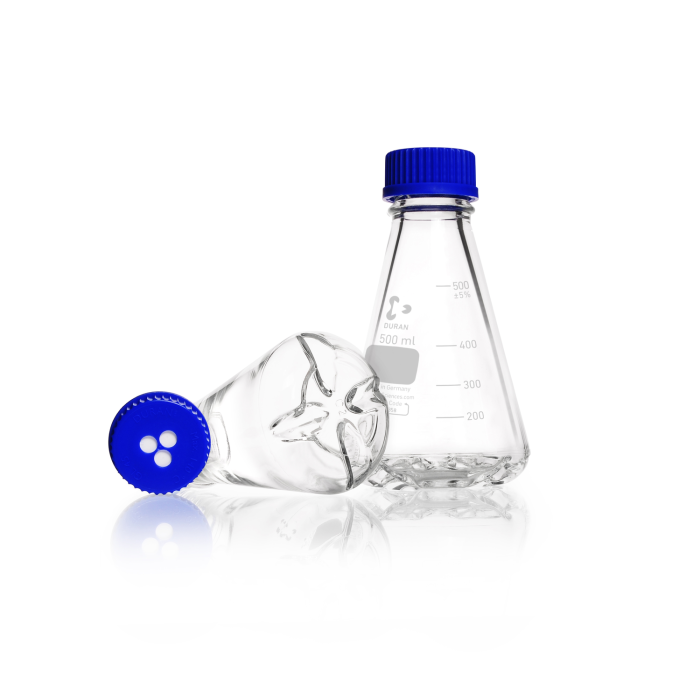
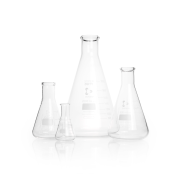
DURAN® Baffled Flask, with GL 45 thread
- Manufactured from borosilicate glass 3.3
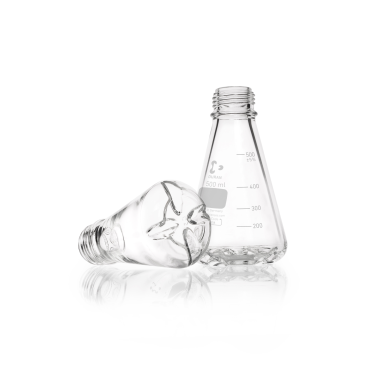
- Four baffled-bottom flasks cause a turbulent flow, increase the gas exchange surface and produce a higher oxygen transfer
- At higher shaking speeds, the baffles increase aeration for better growth, especially with bacteria
- The moulded bottom-baffles provide increased movement at lower speeds for a more gentle medium aeration of sensitive cultures
- The flasks can therefore be sealed with the tried-and-tested membrane screw cap from the DWK Life Sciences which enables a reproducible gas exchange compared to other sealing mechanisms e.g. sealing with cotton wool
- The special production process enables the manufacture of the product complete with thread in a two-stage process
- Available in range of three sizes for process scale up, with and without membrane screw cap and pouring ring
- The increased wall thickness of the flasks ensures excellent mechanical stability and a long service life.
- Easy-to-read scale with graduation marks to estimate the content
- Fired-on, highly durable white print

| Catalog No | Capacity (mL) | Diameter d (mm) | Height h (mm) | Thread | Quantity | |
|---|---|---|---|---|---|---|
| 212833655 | 250 | 85 | 145 | GL 45 | 4 | Find a distributor |
| 212834454 | 500 | 105 | 180 | GL 45 | 4 | Find a distributor |
| 212835459 | 1000 | 135 | 221 | GL 45 | 1 | Find a distributor |
| Catalog No | Capacity (mL) | Diameter d (mm) | Height h (mm) | Thread | Quantity | |
|---|---|---|---|---|---|---|
| 212833606 | 250 | 85 | 145 | GL 45 | 4 | Find a distributor |
| 212834405 | 500 | 105 | 180 | GL 45 | 4 | Find a distributor |
| 212835401 | 1000 | 135 | 221 | GL 45 | 1 | Find a distributor |
Specifications
Product specifications are found on the product detail pages. Click on the product catalog number in the table above to view the individual product specifications.



| Catalog No | Capacity (mL) | Diameter d (mm) | Height h (mm) | Thread | Quantity | |
|---|---|---|---|---|---|---|
| 212833655 | 250 | 85 | 145 | GL 45 | 4 | Find a distributor |
| 212834454 | 500 | 105 | 180 | GL 45 | 4 | Find a distributor |
| 212835459 | 1000 | 135 | 221 | GL 45 | 1 | Find a distributor |
| Catalog No | Capacity (mL) | Diameter d (mm) | Height h (mm) | Thread | Quantity | |
|---|---|---|---|---|---|---|
| 212833606 | 250 | 85 | 145 | GL 45 | 4 | Find a distributor |
| 212834405 | 500 | 105 | 180 | GL 45 | 4 | Find a distributor |
| 212835401 | 1000 | 135 | 221 | GL 45 | 1 | Find a distributor |
Specifications
Product specifications are found on the product detail pages. Click on the product catalog number in the table above to view the individual product specifications.
Frequently Asked Questions
In an unbaffled Erlenmeyer flask on a shaker, the swirling motion tends to create a smooth vortex with limited surface area. This can restrict gas exchange. Baffled flasks introduce internal ridges or protrusions that break up the vortex and create agitated or turbulent flow, dramatically increasing the liquid’s surface area exposed to air. The result is greater oxygen dissolution into the culture, promoting better cell growth and higher yields.
The choice between side baffles and bottom baffles depends largely on the culture being grown. Side-baffled flasks feature four indentations in the flask walls that create strong turbulence throughout the culture, maximising oxygen transfer and mixing. This makes them particularly well suited to bacterial, yeast, and other high oxygen-demand microbial cultures. In contrast, bottom-baffled flasks incorporate baffles in the base of the flask, generating turbulence primarily at the bottom while maintaining gentler overall mixing. As a result, they provide enhanced aeration with lower shear stress, making them a preferred option for sensitive cell cultures such as mammalian, insect, and plant cells. Both designs improve oxygen transfer compared to standard flasks, but side baffles prioritise maximum aeration, while bottom baffles offer a balance between oxygenation and gentle culture handling.
For baffled Erlenmeyer/shake flasks, the recommended working volume is generally 10-30% of the flask's total capacity (eg. 50-75mL in a 250mL flask; 100-150mL in a 500mL flask), with the optimum depending on the oxygen demand of the culture. Baffled flasks generate greater turbulence and oxygen transfer than standard flasks, so lower fill volumes are often preferred.
A filter vented cap is designed to allow gases to move in and out of a culture vessel while maintaining a barrier against microbial contamination. These caps are commonly used on shake flasks and other culture vessels containing suspension cell cultures, bacteria, yeast, or fungi. The use of a filter vented cap helps support healthy cell growth, higher culture performance, and reduced contamination risk. They provide better contamination control and more consistent culture performance than more basic alternative solutions such as cotton plugs or foil.
A baffled shake flask uses orbital shaking and internal baffles to increase turbulence, mixing, and oxygen transfer, making it ideal for microbial cultures and suspension-adapted mammalian cells. A spinner flask uses a mechanical stirring paddle to keep cells evenly suspended and is commonly used for mammalian cell expansion, hybridoma culture, and cell adaptation to suspension growth. In general, baffled flasks are preferred for high-aeration protein and antibody production workflows, while spinner flasks are better suited for maintaining homogeneous cell suspensions.
Baffled shake flasks are best cleaned by rinsing immediately after use to prevent media, proteins, or cells from drying onto the glass, followed by soaking in a warm laboratory-grade detergent solution and thoroughly brushing around the baffles where residues can accumulate. The flask should then be rinsed well with tap water and finally with deionized or distilled water to remove any detergent traces before being air dried or autoclaved for reuse. For heavily used cell culture flasks, an overnight detergent soak and cleaning in a laboratory glassware washer can help ensure thorough removal of residues from hard-to-reach baffled areas.